
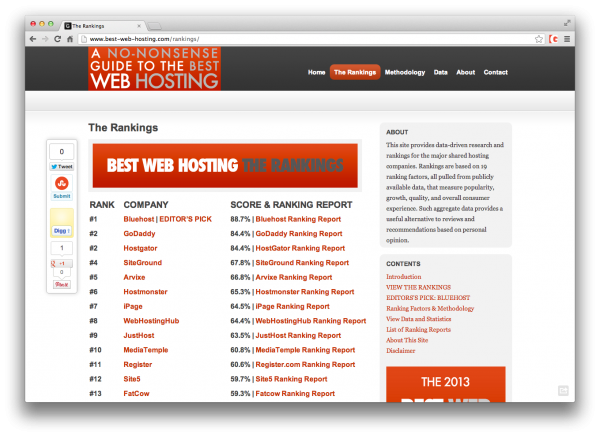
I recently came across a new website that offers interesting reviews of popular web hosts. The reason I think it’s interesting is because the website doesn’t use personal opinions about the hosting companies. In fact, it claims to be a no-nonsense guide to the best web hosting.
The website actually uses data from a variety of sources to determine what the best web hosting company is out there. Mind you, it really only covers shared hosting services, so there aren’t any WordPress managed hosting providers listed explicitly.
But the criteria it uses includes:
- Webhosting.info statistics
- Opensiteexplorer.org data
- Alexa statistics
- Twitter pages
- Twittercounter statistics
- Facebook pages
- Google Trends data
- Webhostinggeeks reviews
- Better business bureau ratings
To my surprise, here are the top five web hosts listed on the site.
- Bluehost with a score of 88.7%
- GoDaddy with a score of 84.4%
- Hostgator with a score of 84.4%
- SiteGround with a score of 67.8%
- Arvixe with a score of 66.8%
Some of the sites in the list I have never heard of, but maybe you have. I recommend checking it out, as it’s a refreshing way of looking at what’s out there for hosting WordPress websites.
Is this legit? Is this something that you’d trust for you and perhaps even your clients?


Do they have a statistic for sites most likely to be hacked?
I personally have decided a long time ago to do away with shared hosting. It is nothing but trouble if you ask me. You pay for what you get.
I used to run my own server on Media Temple, which end badly but am now using Blogdroid which is Managed Hosting and I love it.
Super fast, secure and works well.
I use WP Engine personally, and am very happy with it. I wish the prices were a little better but you definitely do get what you pay for.
That’s good to hear. Thinking of giving them a whirl. Worth paying good money for a good service, especially if your site is more than a hobby.
Really great referral payouts, by the way — that WP Engine.
They definitely do, but expensive hosting is a hard affiliate sell.
The problem with shared hosting is always the host. There are exceptions — shared hosts who actually do it right. Fixed limits on users and domains, secure and optimized for WordPress, Magento, whatever. Real support. Privately held, built and own their own datacenters, etc. This is also what makes a good host for a VPS or dedicated server.
Something to keep in mind is that web hosting affiliate programs pay out some of the biggest referrals in affiliate marketing. Some of the hosts listed there are paying out $50 – $150 per referral. So while the methodology is interesting, the selection is more or less the same as the other sites infested with fake reviews/ratings. It’s not a complete picture.
Perhaps the scores are totally legit though. To their credit, they list Bluehost as #1 and they themselves host that site on Bluehost.
I’m sure there is some sort of personal opinion, but at the same time there is data behind it. Is it valid? I dunno. But it sure is an interesting approach.
I disagree that it’s interesting insofar as the hosts they are using are all the usual suspects and every link is affiliate loaded. Plus, all this “data” really proves is who has the most SEO juice, which let’s be totally honest, is almost always at least partially indicative or an affiliate strategy.
I wasn’t going to do this, but I’m actually going to completely nullify the entire ranking qualities right now because they are bullshit and are weighted almost entirely based on size of the web host and/or size of the SEO/affiliate/spam trap.
For instance, what’s the point of counting stuff like Alex rank, Facebook and Twitter followers as much as something like a BBB score? All this does is give an advantage to companies that have a larger social media presence — a presence that says absolutely nothing abou their ability as a host. GoDaddy has a lot of Twitter followers. Great. I still wouldn’t recommend them to my worst enemy. Apparently this has been altered to be more fair, but the fact that it’s part of the ranking is insipid.
It would still be suspect, but a much more fair representation of social data would be to gauge sentiment about a brand on Twitter, rather than look at follower counts.
Now, let’s look at those BBB rankings. Ignoring the fact that the BBB is totally useless in this case, because most complaints with digital companies aren’t filed through the BBB and getting detailed info from that organization can cost money, let’s just assume (and to be clear, I think BBB rankings for stuff like this are full of shit) that this stuff matters:
Mathematically, the entire way they are trying to give a rating is flawed. They are comparing complaints against 10,000 linking domains. First of all, I seriously doubt they have that domain info. Second, that assumes that each domain represents a single customer. This is absolutely false.
A more fair representation would be the number of complaints over X years as an average and whether or not complaints are on the rise or on the decline.
Then, let’s look at the site they are using to get their review info from: it’s a spammy, spammy, affiliate marketing cesspool overrun with affiliate links. Exactly the type of data I want informing my opinion.
Oh — and let’s not forget the Google Trends piece. That’s based just on relative search volume, not search content. Why not do a ranking of how many “host sucks” sites or articles or results exist? Oh, would that negate some of the hosts on the list who happen to pay the best affiliate payments? Yes, yes it would.
This whole thing is a shit show and I have to wonder if you are affiliated with the site or even writing this kind of stuff. It’s grotesque and as I said in another comment, it’s 2013. Time for this transparent shill stuff to stop.
/Rant
I’m not affiliated with the site but do find the method of finding the rankings interesting. I don’t look at it from a SEO front. I just enjoy seeing different views something familiar. For example, http://wpdaily.co/rankwp/ vs http://wpdaily.co/uproot-us/
I don’t trust this.
Anyone who’s worked in development can easily recognize that many of the “top hosts” have caused significant problems with developers when maintaining their applications or providing support.
Basically, I call into question the metrics used to grade the web hosts. Things like Twitter followers, Facebook likes, etc. can all be generated using tools like TweetAddr.
On top of that, clever marketing can drive traffic thus increasing Analytic ranking.
There are plenty of products on the market both online and offline that users use because believe it to be the best value when, in fact, it’s more of a limited budget host.
For some, that works and that’s great (don’t misunderstand me), but these rankings? meh.
Customer happiness – be it users or developers – is one thing that’s sorely missing.
They are using BBB information as part of the rankings, but customer happiness from each host is likely not public info for most.
Does it use affiliate links to each host? Then it’s not legit. Anyone ranking GoDaddy so highly should be immediately discounted as far as I’m concerned.
Yup! In fact, each link is a 301 redirect that tries to hide the affiliate link from the reader.
In fact, some of them go through multiple redirects (all hidden), which means multiple affiliate paths.
Scammy, scammy, scammy.
And unfortunately nearly all host recommendation sites — especially with a scammy URL like this one — are like this. They say whatever needs to be said to feed the commission link.
The same goes for nearly every “unbiased” review and even various webhosting forums. Really, the only way you can be sure is to play the whack-a-mole game of hosting, understand that you get what you pay for (in most cases) and ask someone you know their general experience with a host first.
The saddest part is that in 2013 shit like this still works.
I don’t trust this at all, because they don’t include one of the most important factors – site speed. In my experience with most of the top-ranked hosts on this list, sites on their servers run painfully slowly. If I were making a list ranking web hosts, I would want criteria like:
– site speed
– average server load
– how they respond when a site sees a spike in traffic (I’ve seen sites on shared hosts get shut down because they got posted on Digg or Slashdot)
– software versions (I’ve seen shared hosts run 2-year-old versions of PHP)
– security (what do they do to stop hackers?).
I couldn’t care less how many Twitter followers a web host has – I want them to have secure and fast servers!
Check our site for affordable website hosting.
I always check out this website before buying hosting – http://www.url-store.com – My personal favourite is hostgator because they’re the simplest and usually the cheapest for new hosting packages.
Hello This goes in regaurds to what Morgan Kay Was saying site speed is one of the most important things when it comes to hosting if you don’t have site Speed you can’t get nothing done and getting stuff done is imortant when it comes to being an affiliate or whatever the case may-be doesn’t matter if you don’t have speed what do you really have if you want hosting you can really relly one ill give you a link you guys can check out this is what I’ve used since i became an affilate and its failed me not 1 time check it out [affiliate link removed].
Http://www.homewreckers.webs.com maybe not for some reason I can’t paste it just check out my website and there’s a link to it thanks